
Discover Montessori at pop e poppa
At pop e poppa, we provide an environment that respects each child's rhythm, nurtures independence and strengthens self-confidence.

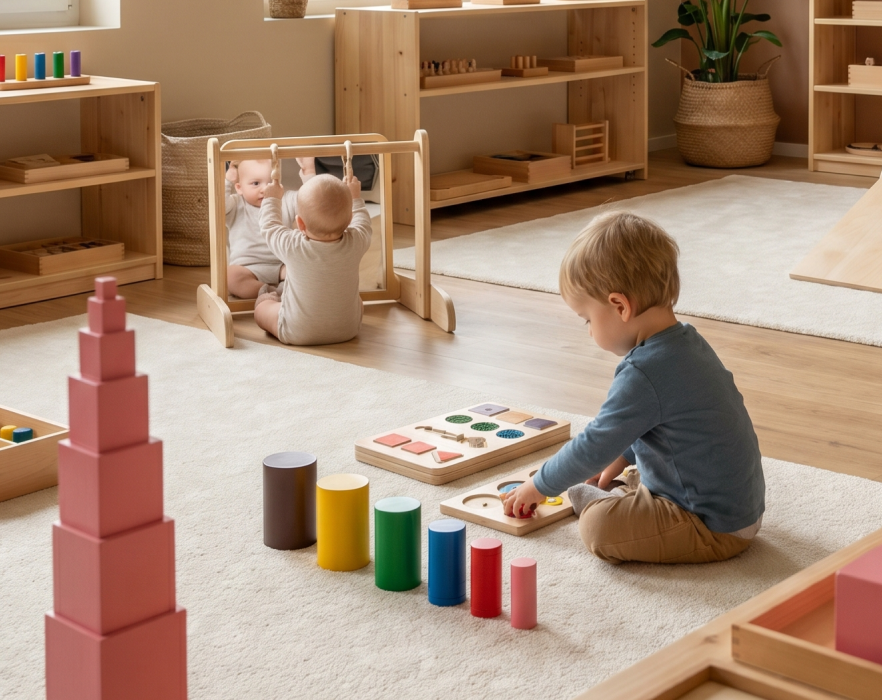
Your child is already learning on their own.
What if their daycare supported that natural drive?
From the very first days, your child is exploring the world with a remarkable natural curiosity. They observe, touch, experiment and repeat. This is precisely what Dr. Maria Montessori discovered over a century ago while observing children who were free to choose their own activities in a carefully designed space. Her conclusion, now supported by modern neuroscience, can be summed up in one sentence.
“Help me do it myself.”
This philosophy also shapes our pop e poppa daycare centres. We provide children with an environment that respects their rhythm and strengthens their self-confidence.
Core principles of Montessori education
The prepared environment
The goal of Maria Montessori's pedagogy is a respectful and understanding interaction between adults and children, with a focus on honoring the child's personality. The child's needs and the promotion of independence are central. The uniqueness of each child is always acknowledged, and every child has the freedom to choose from activities that match their individual needs.
Freedom of choice and child-led learning
Children choose the materials and the duration of the activity independently. This freedom of choice fuels intrinsic motivation and builds concentration from an early age. There are no rewards or punishments. The activity itself is the source of satisfaction and learning.
Learning through the senses and movement
Young children discover the world through touch, sight, hearing, taste and smell. Montessori materials are specifically designed to stimulate sensory development and build both fine motor skills and gross motor skills. Pouring water, stacking shapes, sorting by colour or size... each hands-on activity develops lasting cognitive and physical abilities.

At pop e poppa, Montessori meets our own educational vision
The Montessori method is not a rigid formula. The principle ‘Help me do it myself’ by Maria Montessori shapes different aspects of our day-to-day practice in our daycare centres. Children are empowered to carry out tasks according to their own abilities and knowledge, tasks that adults might otherwise do for them.
Eating independently at mealtimes, choosing their own activity, putting things back in their place... this way every moment of the day becomes an opportunity for learning and growth.
However, our daycare centers go beyond a strict application of the Montessori method. Our educational daily practice is shaped by reflection and continuous development, drawing on various pedagogical approaches the latest findings in developmental neuroscience to offer a well-rounded programme. Our vision shares a core conviction with Maria Montessori. Every child is unique, and the relationship between adult and child must be built on respect, attentiveness and trust.

Language
Vocabulary building across categories, early preparation for reading and writing, verbal and non-verbal communication skills

Sensory perception
Visual discrimination of different shapes, textures and weights through touch and hands-on manipulation of Montessori materials.

Colour recognition
Perceiving, naming and differentiating colour shades, building visual discrimination abilities.

Auditory memory
Recognising, classifying and differentiating sounds, voices and environmental noises.

Practical life skills
Everyday tasks such as pouring a drink, tidying up and getting dressed that build autonomy and self-confidence.

Motor development
Fine motor skills (grip, hand-eye coordination) and gross motor skills (walking, balance, spatial awareness).
Want to learn more?
Discover our educational approach and our “my journey through life” which supports every child on their life's journey.
Each of these centres integrates Montessori principles into its educational programme, while benefiting from the expertise and support of the wider pop e poppa network.
Frequently asked questions about Montessori daycare

How do we support children’s independence?
In our centers, children take on everyday tasks largely on their own, for example getting dressed, setting the table, or tidying up. The environment is deliberately designed to enable independent action: materials and objects are accessible to children, and routines are clearly structured.
Our educators observe children attentively, offer gentle guidance, and only step in when necessary. In this way, children experience a sense of self-efficacy, responsibility, and confidence in their own abilities.
What are Montessori materials and why are they important?
Montessori materials are specially designed learning tools that help children learn independently and at their own pace. They are clearly structured and each focuses on a specific learning goal, allowing children to gain experience step by step. The materials engage multiple senses and make abstract concepts like language or mathematics tangible and concrete. This hands-on approach enables children to learn through doing and develop a lasting understanding.
In our centers, Montessori materials are introduced thoughtfully and guided by the educators. Afterwards, children have time to work independently, practice, and deepen their skills.
What are the learning areas in Montessori pedagogy
Montessori pedagogy is structured around five core learning areas that support the whole development of the child:
- Practical Life Exercises: Children practice everyday actions such as pouring, cutting, setting the table, dressing, or cleaning. These activities foster independence, responsibility, and understanding of daily routines.
- Sensorial Materials: Children explore colors, shapes, sounds, weights, and textures. They refine their senses, compare and classify, strengthening perception and concentration.
- Language: Children work with letters, sounds, word cards, or small writing exercises. They practice speaking, reading, and writing in a playful and active way.
- Mathematics: Children use tools like number rods, counting beads, or math materials to make numbers, quantities, sequences, and operations visible and concrete.
- Cosmic Education: Children discover nature, environment, culture, and society through observation, experiments, stories, or gardening. They learn about connections and develop a sense of responsibility for the world.
What makes Montessori different from regular childcare?
In Montessori pedagogy, educators guide children instead of instructing them. They observe carefully and only intervene when necessary, aiming to promote children’s independence, concentration, and initiative.
Key aspects of this approach:
- Guide, don’t control: Children are allowed to discover independently
- Patience and respect: Educators trust in the child’s “inner blueprint.”
- Error-friendly: Mistakes are treated as learning opportunities, not failures.
- Prepared environment: Materials and spaces are arranged to allow children to act independently.
- In short, the educator is an observer, supporter, and guide who creates conditions for children to engage actively and learn on their own.